Key takeaways
- Bitcoin (BTC) rebounds above $60,800 on Thursday but remains vulnerable to further losses amid persistent institutional selling pressure.
- US spot Bitcoin ETFs recorded $453.12 million in net outflows on Wednesday, marking their seventh consecutive day of withdrawals.
- Bitcoin faces immediate resistance at $62,703, while renewed selling pressure could trigger a retest of its yearly low of $55,130.
Bitcoin (BTC) extended its recovery on Thursday, trading around $60,850 after posting modest gains in the previous session.
However, the cryptocurrency remains firmly within a broader downtrend as persistent institutional withdrawals, inflation concerns, and escalating geopolitical tensions weigh on investor sentiment.
Record monthly outflows from US spot Bitcoin exchange-traded funds (ETFs) continue to undermine buying demand, while expectations of further Federal Reserve interest rate increases threaten to limit recovery attempts.
Although technical indicators suggest that bearish momentum is gradually weakening, Bitcoin remains vulnerable to another significant correction.
Bitcoin ETF outflows hit record $5.39 billion in November
Institutional selling pressure continues to weigh heavily on Bitcoin, which has erased most of its third-quarter gains after reaching a yearly low of $55,130 last week.
According to SoSoValue, US spot Bitcoin ETFs recorded $453.12 million in net outflows on Wednesday, extending their withdrawal streak to seven consecutive trading days.
More concerning is the scale of institutional withdrawals throughout November. Bitcoin ETFs have recorded cumulative net outflows of $5.39 billion so far this month, marking their largest monthly withdrawals since launching in January 2024.
If withdrawals continue at the current pace, Bitcoin could struggle to establish a sustainable recovery, increasing the risk of another test of its yearly low.
Bitcoin’s recovery prospects face additional challenges following the release of the latest US Personal Consumption Expenditures (PCE) Price Index.
Headline PCE inflation increased by 0.3% in October, while the annual inflation rate accelerated to 3.8%, compared with September’s upwardly revised reading of 3.7%.
Meanwhile, core PCE inflation, which excludes volatile food and energy prices, climbed to 3.3% annually from 3.1% in September, exceeding market expectations.
The stronger-than-expected inflation reading reinforced expectations that the Federal Reserve will raise interest rates at its December policy meeting.
Escalating Middle East tensions weigh on risk appetite
Renewed geopolitical tensions in the Middle East are adding another layer of uncertainty to global financial markets.
Iran-backed Houthi forces claimed responsibility for attacks targeting Saudi Arabia, while the Saudi-led coalition reported retaliatory strikes against Houthi targets in Yemen.
The escalating conflict could increase concerns about regional stability and energy supplies, potentially adding to existing inflationary pressures.
These developments, combined with expectations of tighter US monetary policy, could strengthen demand for the US dollar and discourage exposure to risk-sensitive assets.
Consequently, Bitcoin’s recent rebound could struggle to gain momentum as investors navigate an increasingly uncertain macroeconomic environment.
Bitcoin technical forecast: Recovery attempts could attract fresh selling pressure
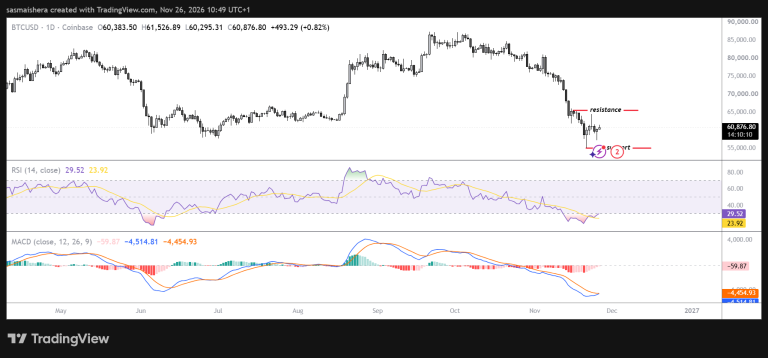
Bitcoin trades around $60,880 on Thursday but remains significantly below its major daily Exponential Moving Averages (EMAs).
The 50-day EMA stands at $71,569, while the 100-day and 200-day EMAs are positioned at $73,703 and $74,726, respectively.
Momentum indicators continue to reflect bearish market conditions, although selling pressure appears to be moderating.
The daily Relative Strength Index (RSI) stands near 29, indicating oversold conditions. Meanwhile, the Moving Average Convergence Divergence (MACD) remains negative, although its narrowing histogram suggests weakening downside momentum.
These readings leave room for a short-term relief rally but do not confirm a broader bullish reversal. Bitcoin faces immediate resistance at $62,703, corresponding to the 23.6% Fibonacci retracement level of its recent decline.
A successful breakout could expose the 38.2% and 50% Fibonacci retracement levels at $67,388 and $71,175, respectively.
However, a dense resistance zone between $71,569 and $74,961, comprising major moving averages, Fibonacci levels, and a previously broken trendline, could limit further upside.
On the downside, Bitcoin’s next meaningful structural support remains its yearly low of $55,130, where some bearish traders could begin taking profits.
For now, record ETF withdrawals, persistent inflation, and mounting geopolitical uncertainty continue to overshadow improving momentum indicators. Unless institutional demand recovers and Bitcoin reclaims key resistance levels, relief rallies could attract renewed selling pressure.
The post Bitcoin recovery remains fragile as ETF outflows hit a record $5.39B appeared first on CoinJournal.